- HOME
- TOURS
- DESTINATIONS
Aotearoa - untamed
Vibrant + electric
- TRAVEL GUIDES
Budget, packing and more
Everything you need to know
- ABOUT US
- CONTACT
Getting to Laos & the Mekong River Homestay

31 August | 10 min read
Contents
- Getting to Laos & the Mekong River Homestay: The Complete Guide
- Getting to Laos overland
- Getting to Laos by air
- The slow boat: the best way to arrive in Laos
- The Mekong River Homestay: Laos as only Stray can show you
- Getting there with Stray
- FAQs
Getting to Laos & the Mekong River Homestay: The Complete Guide
Laos doesn't do fast. Locals joke that Laos PDR stands for 'Please Don't Rush', and nowhere proves the point better than arriving the classic way: drifting up the Mekong River on a slow boat, past water buffalo, fishing villages and jungle-covered mountains, to a tiny riverside village that no other tour group visits.
This guide covers every practical route into Laos, by land border and by air, from Thailand, Cambodia, Vietnam and China, plus the experience most travellers never get to have: an overnight stay at Stray's exclusive Mekong River Homestay.
Getting to Laos overland
Laos is landlocked and shares borders with five countries, which makes it one of the easiest places in Southeast Asia to reach overland. Here are the main crossings travellers actually use.

From Thailand
North: Huay Xai is the Lao border town on the Mekong River, directly opposite Chiang Khong on the Thai side, on the route north from Chiang Mai and Chiang Rai. Travel with Stray from Bangkok through to Huay Xai, or complete the border crossing independently and join the trip there. This is also where the famous two-day slow boat journey to Luang Prabang begins (more on that below).
Northeast: Vientiane, the Lao capital, is a half-hour tuk-tuk ride from the Friendship Bridge on the Lao-Thai border. The town on the Thai side is Nong Khai, connected to Bangkok by overnight train. From the station in Nong Khai, a combination of tuk-tuks and buses takes you across the bridge, through immigration and into town. Travelling the other way, you can buy a train ticket from Vientiane, exit Laos at Thanaleng station on the Lao side, and complete Thai entry immigration on the platform at Nong Khai before boarding the overnight train.
East: Pakse, in Champasak Province in southern Laos, is reached from Thailand via Ubon Ratchathani, which is linked to Bangkok by bus, train and plane. From Ubon Ratchathani it's roughly a 2-hour bus trip, depending on time spent at the border crossing.
From Cambodia
The 4,000 Islands area in Champasak Province borders the Cambodian province of Stung Treng. Buses run daily from Phnom Penh to Stung Treng (about 6 hours), then minibuses continue to the border at Dom Kralor (about 2 hours). From Voen Kham on the Lao side, minibuses and other transport run to Ban Nakasang, where a boat crosses to Don Det.
For this crossing it's recommended to arrange your Lao or Cambodian visa in advance, and even with visas in hand, officials may ask for stamp fees. Plan around the border's opening hours of 8am to 5pm, and double-check visa availability well ahead of time as arrangements at this border can change.
From Vietnam
The most common route from Vietnam is flying from Hanoi to Luang Prabang or Vientiane, a one to two hour flight. If you're combining a Vietnam tour with a Laos tour, flying to Vientiane is the recommended option.
The overland route from Hanoi is possible if you have time and patience, but it's particularly difficult on the Vietnamese side. The crossing sits between Nam Xoi in Hua Phan Province, Laos, and Nameo in Thanh Hoa Province, Vietnam. Large tuk-tuks run between the border and Vieng Xai (2 hours) on the Lao side, while on the Vietnamese side rides can be negotiated from Thanh Hoa or Ba Thuoc. Arrange visas before reaching the border, as there's no guarantee they'll be available on arrival.
From China
The crossing between China and Laos links the Xishuangbanna area of Yunnan with Luang Nam Tha Province. Buses from Kunming, Xishuangbanna and Meng Le connect to Mohan on the Chinese side, then through to Boten in Laos, where onward buses run to Oudomxai, Luang Nam Tha and Huay Xai. Lao visas are available on arrival at this border, but Chinese visas are not and must be prearranged. The border is open 8am to 4pm, so arrive early in the day to catch connecting buses.
Getting to Laos by air
- Lao Airlines: connects Vientiane with Kunming, Hanoi, Ho Chi Minh City, Phnom Penh, Siem Reap and Bangkok, links Pakse with Siem Reap and Bangkok, and connects Luang Prabang with Bangkok, Chiang Mai, Hanoi and Siem Reap.
- Bangkok Airways: connects Bangkok with Luang Prabang, plus Chiang Mai, the southern Thai islands, Siem Reap and Phnom Penh.
- Air Asia: flies to Vientiane from Kuala Lumpur, a handy connection from Australia, New Zealand, Europe and other Asian hubs.
- Vietnam Airlines: connects Luang Prabang with Hanoi and Siem Reap, and Vientiane with Hanoi, Ho Chi Minh City and Phnom Penh.
Visas at a glance
Most nationalities, including travellers from the UK, EU, US, Canada, Australia and New Zealand, need a visa for Laos. A single-entry visa valid for 30 days is available on arrival at airports and most land borders (around $40 USD; bring cash and passport photos). Multiple-entry visas require advance application, and you're responsible for arranging the visas you need. Check the latest requirements before you travel.
The slow boat: the best way to arrive in Laos
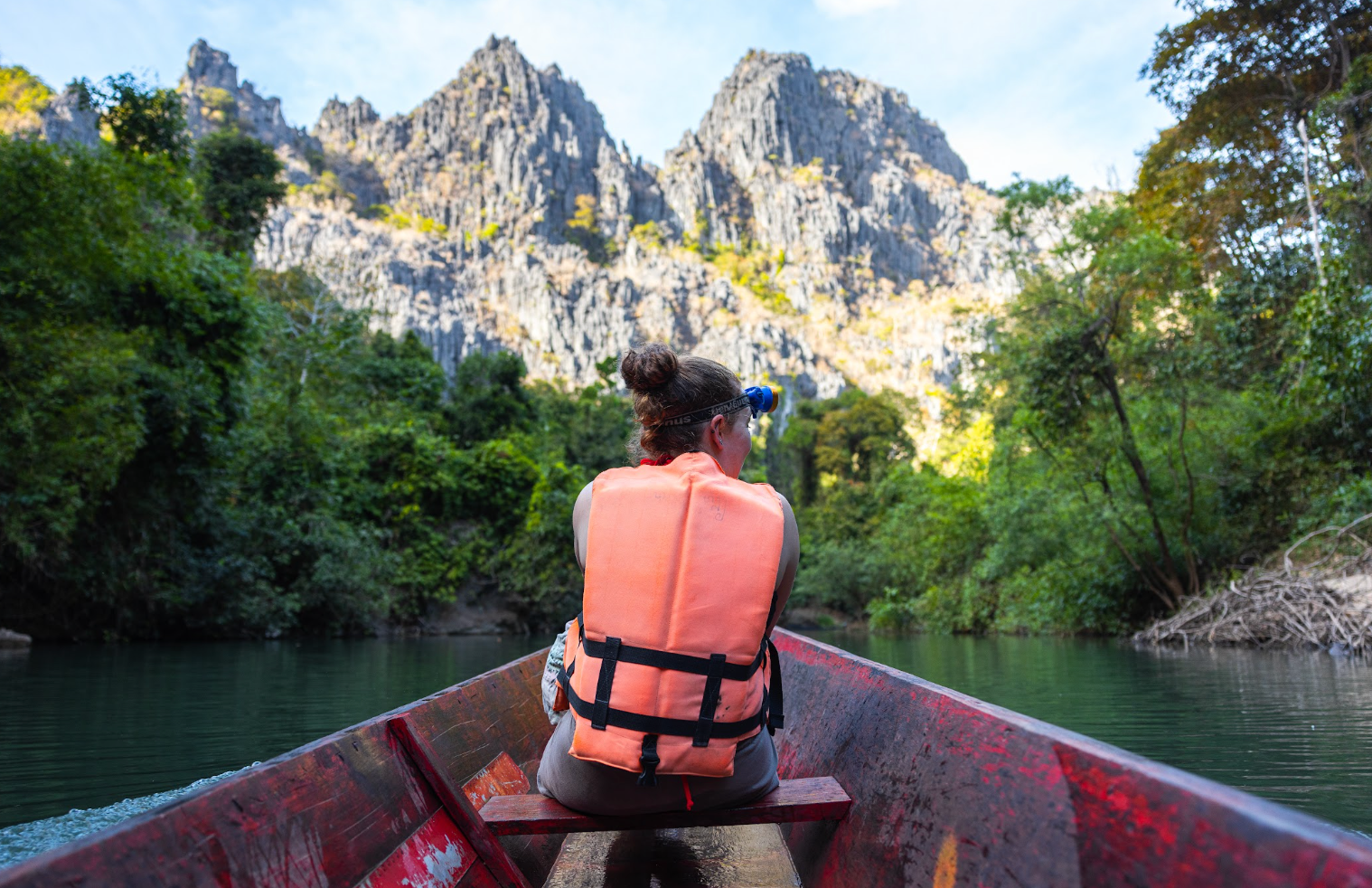
If you cross at Huay Xai, don't rush south by bus. The two-day slow boat journey down the Mekong to Luang Prabang is one of Southeast Asia's great travel experiences, and Stray does it on a private boat, winding through lush farmland, thriving jungle and rugged mountain scenery, drifting past water buffalo, locals fishing and kids splashing in the shallows.
The overnight stop is what makes Stray's version different. Instead of the crowded public boat and a guesthouse town, you spend the night at the Mekong River Homestay, a village stay no other group offers.
On the second morning, the boat heads downriver to the famous limestone Pak Ou Caves, home to thousands of Buddhist images placed there over hundreds of years, before a short final leg to the UNESCO World Heritage town of Luang Prabang.
The Mekong River Homestay: Laos as only Stray can show you
Around 800 people live in this tiny, 400-year-old settlement on the banks of the Mekong, and Stray is the only group that visits. It's about as off-the-beaten-track as travel gets: as you arrive, the local children come out to greet you, the village Chief formally welcomes you, and in the evening you're invited into a traditional Baci ceremony.
The vibe is welcoming, friendly and warm. The village sees very little tourism and genuinely appreciates the visitors it does get, so expect a 'sabaidee' (hello) and a smile as you wander past people's homes.
The Baci ceremony
The Baci ceremony (also spelled Baci Soukhuan) is a traditional Lao ritual used to celebrate important life events, welcome guests, and bring good luck by tying cotton strings around a person's wrists to secure the 32 components of the soul.
The highlight of the stay. This special Lao ceremony takes place after dinner in the village hall and involves prayer, Lao whiskey and the villagers tying 32 cotton bracelets around your wrists, one for each of the 32 components of the soul. The ritual is believed to protect you, bring good luck and health, and leave a small piece of you wherever your travels take you. It ends in a singalong: the villagers sing in Lao, then you return the favour in English. A proper Lao-style party.
Take a dip in the Mekong
With very limited amenities in the village, the Mekong is central to daily life: it's where villagers bathe, wash clothes and where the kids play. There's no better way to embrace village life than jumping in yourself. Not ideal for washing your hair, but refreshing, fun and even better with the local children in their element around you.
Walk the village
Simply wandering the village is worthwhile: a window into a way of life very different from home. The village is steadily developing and there's always some construction underway, so take a minute to soak it all in.
Eating and drinking
There are no restaurants or bars in the village. A delicious traditional Lao group meal is prepared for you on the slow boat, with vegetarian and non-vegetarian options, and the boat stocks a few cold beers and drinks in the chilly bin if you fancy one as the sun goes down over the river.
Things you need to know
- Lao culture is conservative. Around the village, cover shoulders and knees, and avoid bikinis, short dresses, shorts or halter-neck tops.
- Under Lao law, romantic relationships between foreign visitors and Lao nationals are restricted, so be respectful and mindful of local rules.
- Expect to pay if you order a beer or buy food or drinks from the local shop.
- If you're offered a shot of home-brewed Lao Lao (rice whisky), you normally don't have to pay.
Travel that gives back
A contribution from the cost of each traveller's stay goes to the village project fund, so every visit directly supports the community that hosts you. It's a big part of why the homestay is consistently one of the most memorable nights on any Stray Asia trip.
Getting there with Stray
The Mekong River Homestay is the overnight stop on Stray's two-day slow boat cruise from Huay Xai to Luang Prabang, built into selected Stray Asia itineraries. Stray handles the border logistics, the boat and the local connections, so all you need to do is show up in Bangkok or Chiang Mai with your bag packed.
Check out our: Thailand to Laos Explorer and Grand South East Asia Loop
FAQs
What is the easiest way to get to Laos from Thailand?
The two most popular routes are crossing at Huay Xai (opposite Chiang Khong, north of Chiang Mai and Chiang Rai) and crossing the Friendship Bridge near Nong Khai, a half-hour tuk-tuk ride from Vientiane. Overnight trains link Bangkok with Nong Khai.
Do I need a visa for Laos?
Most nationalities do. A 30-day single-entry visa is available on arrival at airports and most land borders for around $40 USD; bring cash and passport photos. Arrange visas in advance for the Cambodia and Vietnam land crossings, where availability isn't guaranteed.
Can I fly into Laos?
Yes. Lao Airlines, Bangkok Airways, Air Asia and Vietnam Airlines connect Vientiane, Luang Prabang and Pakse with Bangkok, Chiang Mai, Hanoi, Ho Chi Minh City, Phnom Penh, Siem Reap, Kunming and Kuala Lumpur.
What is the Mekong River Homestay?
An exclusive overnight village stay on the banks of the Mekong River, visited only by Stray. It's the overnight stop on the two-day slow boat journey from Huay Xai to Luang Prabang and includes a traditional welcome from the village Chief and a Baci ceremony.
What is a Baci ceremony?
A traditional Lao ritual of prayer and blessing in which villagers tie 32 cotton bracelets around your wrists, representing the 32 components of the soul. It's believed to bring protection, luck and good health, and it finishes with a village singalong.
What should I wear at the homestay village?
Dress modestly. Cover shoulders and knees around the village and avoid bikinis, short shorts and halter-neck tops. Lao culture is conservative, and respectful dress is appreciated.