- HOME
- TOURS
- DESTINATIONS
Aotearoa - untamed
Vibrant + electric
- TRAVEL GUIDES
Budget, packing and more
Everything you need to know
- ABOUT US
- CONTACT
Best Way to Travel Around New Zealand

31 August | 5 min read
Contents
- What's the Best Way to Travel Around New Zealand? Bus Tour, Campervan, Car or Public Transport
- Option 1: A guided small-group bus tour
- Option 2: Hiring a campervan
- Option 3: Buying a car
- Option 4: Public transport
- So which option is right for you?
- Bus tours in New Zealand, the Stray way
- FAQs
What's the Best Way to Travel Around New Zealand? Bus Tour, Campervan, Car or Public Transport
So you're coming to New Zealand. Great call. The next decision is the one that shapes your whole trip: how are you going to get around? Guided bus tour, campervan, your own car or public transport, they'll all get you from A to B, but they deliver very different trips for very different budgets.
We've compared every option honestly, pros, cons and real costs, so you can pick the one that fits your travel style. And yes, we run bus tours, so we'll tell you exactly where a tour is the right answer and where it isn't.
Option 1: A guided small-group bus tour
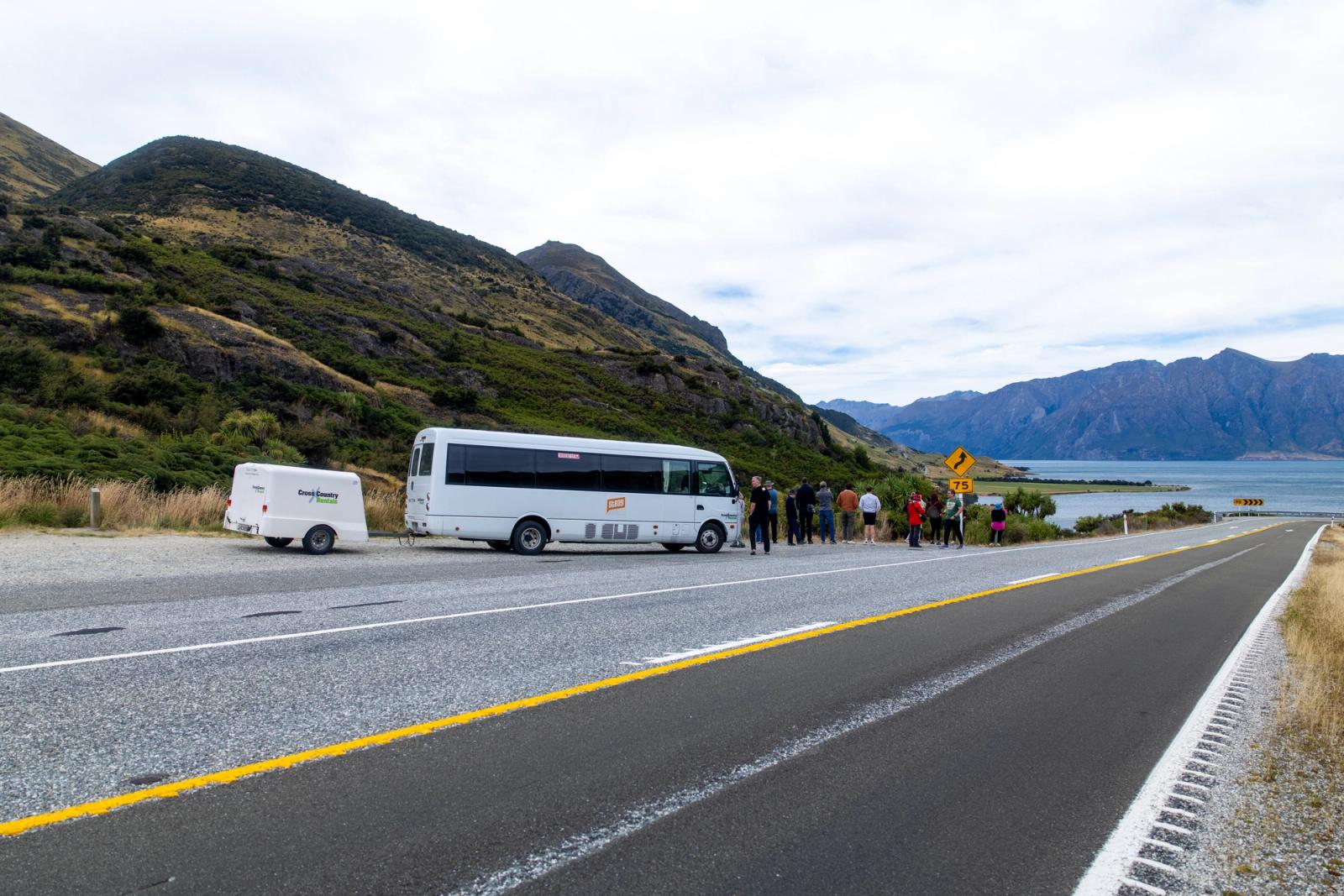
First things first: when we say bus, we don't mean public transport. We mean a small-group adventure tour on a private coach, with a driver-guide, accommodation, activities and a route that's been designed to take in both the icons and the places the guidebooks skip.
The advantages
- Hassle-free: everything is organised for you, with guaranteed accommodation and activities, so you can go with the flow.
- One upfront cost: transport, accommodation, some activities and various meals are covered in a single price, which makes budgeting the rest of your trip much easier.
- Friends made easy: you'll travel with a great bunch of people to share activities and adventures with. Most Stray travellers arrive solo and leave with lifelong mates.
- Sit back and relax: someone else does the driving on New Zealand's winding roads while you daydream out the window at the scenery.
- Local knowledge on tap: your driver-guide shares commentary, top tips and insider info along the way, the stuff you can't find in any search engine.
- Scenic stops built in: the coach stops at points of interest along the route, not just at the towns on the itinerary.
- Eco-friendlier: a full coach means lower CO2 emissions per traveller than everyone driving themselves.
The trade-offs
- you follow a set route rather than going wherever you fancy, although the routes are specifically designed to get off the beaten track.
- it costs more than point-to-point public transport, because you're getting far more than transport from A to B.
Option 2: Hiring a campervan
If a fixed route isn't your thing, a campervan is worth considering: your transport and accommodation in one, and total freedom over where you go and when.
The advantages
- Freedom: go wherever you want, whenever you want.
- Everything in one space: no unpacking and repacking, your camper is your transport and your accommodation in one.
- Accommodation savings: freedom camping (if your van is self-contained) or budget campsites can reduce accommodation spend.
The trade-offs
- campervan and car rental prices in New Zealand have risen significantly in recent years, so check whether the accommodation savings actually offset the hire cost.
- holiday parks (full-service commercial campsites) can be expensive.
- freedom camping takes planning: legal free spots are limited, fines for breaking the rules have increased, and many free sites are basic roadside parking areas rather than scenic spots.
- larger campervans and motorhomes are harder to drive than cars, long days behind the wheel are tiring, and driving on the left takes getting used to.
- living in a confined space with the same person is a genuine test of any friendship or relationship.
Option 3: Buying a car
Plenty of backpackers arrive planning to buy their own set of wheels. It can work, but buying a car in New Zealand is different from buying one at home, so go in with eyes open.
The advantages
- No daily fees: a one-time purchase with no daily hire fees, just fuel and running costs.
- Freedom: go wherever you want, whenever you want.
The trade-offs
- you need some mechanical knowledge to judge a second-hand car, and a seller who's leaving the country next week has little incentive to be upfront about problems.
- driving here is different: winding, narrow roads, gravel and chipseal surfaces, harsh winter conditions in places, and livestock on rural roads.
- breakdowns are on you, and parts of New Zealand have no cell phone reception, with the nearest workshop sometimes hundreds of kilometres away.
- fuel is expensive, diesel vehicles attract road user charges, and toll roads apply to all vehicles.
- car insurance isn't compulsory in New Zealand, so plenty of drivers are uninsured. Get insured, because even an accident that isn't your fault can leave you liable for costs that can't be recovered from the other party.
- the Cook Strait ferry is significantly cheaper as a foot passenger than with a vehicle, and vehicle space can be limited.
- selling at the end of your trip can be tough, especially if you're leaving during a quiet period when demand for used cars is low.
- paid parking in cities and towns adds up over a long trip.
Option 4: Public transport
New Zealand's main cities, Auckland, Wellington and Christchurch, have decent public transport networks, mostly buses. Outside the cities, things thin out quickly, but point-to-point coach services do link the main towns.
The advantages
- Lowest cost: the cheapest way to get from A to B.
- No driving: someone else does the driving.
- Full independence: you build your own itinerary and travel at your own pace.
- Regular schedules: popular routes usually have at least one service per day.
The trade-offs
- no commentary, so you won't know what you're passing or the stories behind it.
- harder to meet people, as there's little mingling on point-to-point services.
- journeys take longer with multiple stops, and you can't pull over at points of interest.
- it isn't door-to-door: you carry your luggage to and from stops and stations.
- accommodation, activities and onward transport are all yours to arrange in every town.
So which option is right for you?
Honestly, it depends on your travel style. If total independence matters more than anything and you're comfortable driving unfamiliar roads, a campervan or car will suit you. If budget is the only factor and you're happy doing all the planning legwork, public transport is the cheapest way from A to B.
But if you want to see the most of New Zealand with none of the admin, meet people along the way, and get to places you'd never find on your own, a small-group bus tour is the most relaxed way to see and do more, and it's the option most solo travellers pick.
Bus tours in New Zealand, the Stray way
Stray's small-group tours are your backstage pass to Aotearoa: the icons like the Hobbiton Movie Set, the Tongariro Alpine Crossing and Hot Water Beach, plus the hidden spots and local communities most visitors never reach. You're not a tourist on a Stray trip, you're an explorer.
Every Stray tour includes:
- Itineraries that know your needs: routes that balance structure with free time, so you get the highlights and the freedom to do your own thing.
- Comfy coaches: private, air-conditioned coaches with big windows made for viewing and vibing, not cramped public buses.
- Handpicked stays: handpicked accommodation in seriously dreamy spots, because good sleep means more fun the next day.
- Foodie vibes: breakfasts and other tasty treats included along the way.
- The crew: small groups and a charismatic Kiwi guide, because the best memories are made with the best people.
Choose your tour style
Every traveller is different, so Stray tours come in tiers to match your budget and your idea of comfort. Whichever you choose, the Stray spirit is the same: small groups, epic experiences and routes that go beyond the obvious.
- Stray Adventure: the famous backpacker tours taken to the next level. Shared dorm-style accommodation, bucket loads of adventure and the excitement dial turned to max.
- Stray Select: comfort meets thrill. Kick back in 3 to 4 star twin or double accommodation after a day of exploring highlights and lesser-known hidden gems.
FAQs
What is the cheapest way to travel around New Zealand?
Public transport is the cheapest per journey, as you're only paying for point-to-point transport. Just factor in the cost and time of arranging your own accommodation, activities and connections in every town.
Can I travel New Zealand without a driver's licence?
Yes. A guided bus tour is the easiest way, since transport, accommodation and activities are organised for you and someone else does the driving. Point-to-point coach services are another option, though you'll need to plan everything else yourself.
Is a campervan cheaper than a bus tour in New Zealand?
Not necessarily. Campervan hire prices have risen significantly, holiday parks can be expensive, and fuel, ferry crossings and campsite fees add up. A bus tour bundles transport, accommodation, some meals and activities into one upfront price, which often compares well once you tally the true cost of a campervan trip.
Do I need car insurance in New Zealand?
It isn't compulsory, but you should absolutely get it. Because insurance isn't required, some drivers are uninsured, and you can be left covering costs even when an accident isn't your fault.
Are bus tours in New Zealand only for backpackers?
No. Stray runs tour styles for different budgets and comfort levels, from dorm-style adventure trips to tours with 3 to 4 star twin or double accommodation, so you can pick the level of comfort that suits you.
What's the best way to travel New Zealand as a solo traveller?
A small-group bus tour. You travel with a built-in crew of like-minded people, a guide who knows all the best spots, and none of the logistics stress, which is why most Stray travellers join solo.